
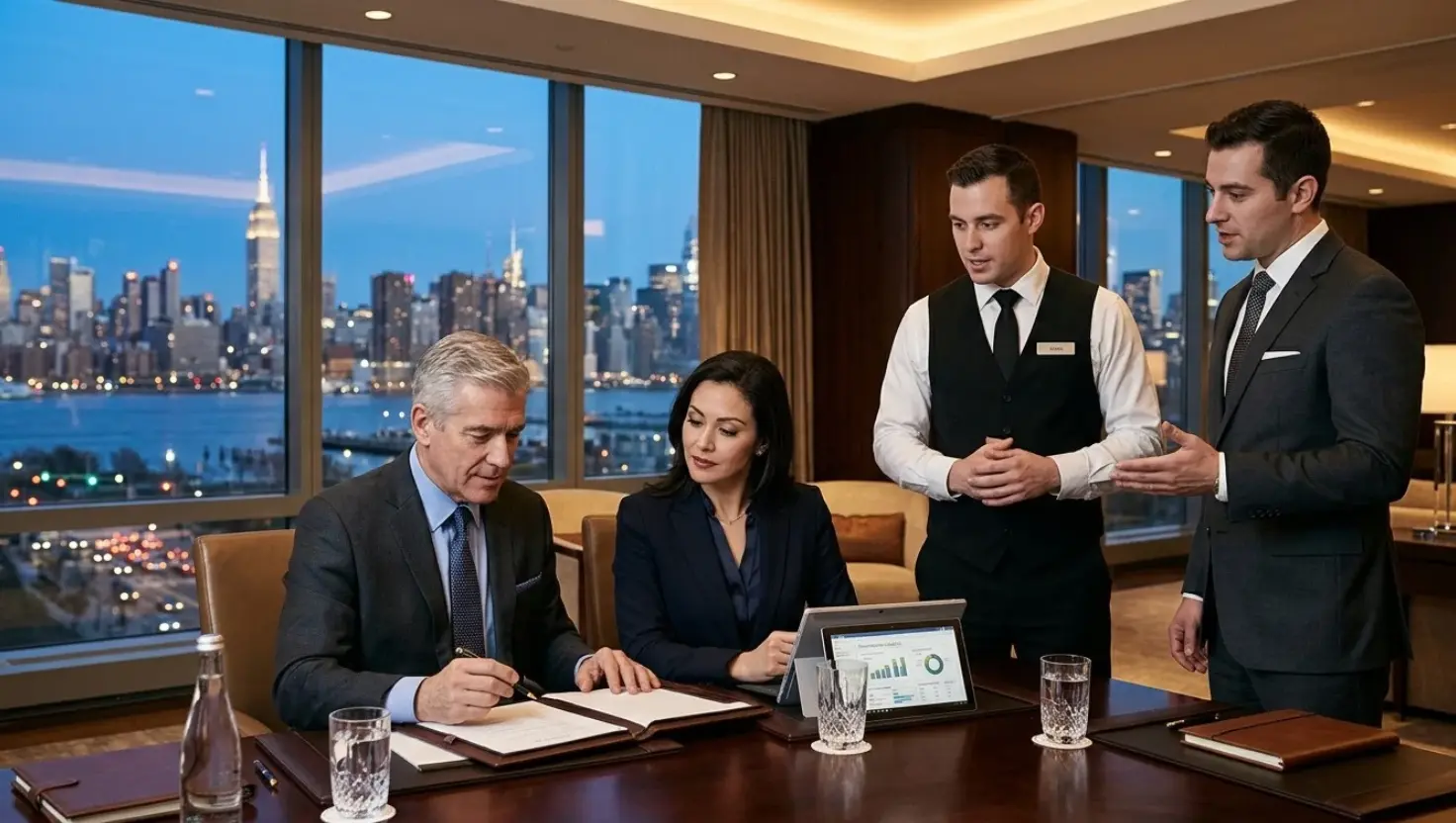
In hospitality staffing, W-2 employees are legally employed by a staffing agency that withholds payroll taxes, carries statutory workers’ compensation, and absorbs full employer liability, whereas 1099 workers are treated as independent business contractors. In the fast-paced hotel and event sectors across New York and New Jersey, classifying front-of-house servers, bartenders, and housekeeping attendants as 1099 contractors creates severe worker misclassification exposure under the IRS Common Law Control Test, the New Jersey Temporary Workers’ Bill of Rights (P.L. 2023, c.10), and New York Labor Law. TrueGigs operates as a tech-enabled W-2 hospitality staffing partner—combining enterprise mobile app dispatch with 100% statutory tax withholding, $5,000,000 in commercial general and liquor liability coverage, and complete joint-employer immunity for venue owners.
1. The Executive Dilemma: App Speed vs. Multi-Million Dollar Liabilities
In today’s hospitality landscape, hotel general managers, food and beverage directors, and country club banquet captains face constant labor volatility. Unpredictable banquet rushes, sold-out convention weekends, and sudden frontline call-offs leave properties scrambling for floor-ready hands.
To solve this shortfall, the strategic question of W-2 vs 1099 hospitality staffing presents two distinctly different models:
- Open 1099 Gig Marketplaces (Instawork, Qwick, Wonolo, etc.): Mobile app boards that dispatch self-employed freelance contractors with minimal operational vetting and zero statutory tax withholding.
- Tech-Enabled W-2 Staffing Agencies (TrueGigs): Licensed workforce solutions providers that combine on-demand mobile dispatch technology with 100% statutory employer protections, full payroll tax absorption, and active supervisory management.
While 1099 gig platforms market themselves as cheap and instant, they shift immense regulatory, tax, and premises liability directly onto venue ownership. Understanding the legal, financial, and operational mechanics of W-2 vs 1099 hospitality staffing is critical to protecting your balance sheet and your brand reputation.
2. Comprehensive Comparison Matrix: W-2 Staffing Agencies vs. 1099 Gig Apps vs. Legacy Agencies
When evaluating W-2 vs 1099 hospitality staffing options, hotel general managers and venue directors must look beyond headline hourly markups. The following matrix contrasts how each labor model operates across essential legal, operational, and financial dimensions:
| Strategic Criteria | TrueGigs (Tech-Enabled W-2 Agency) | 1099 Gig Platforms (Instawork, Qwick, etc.) | Traditional Legacy Agencies |
|---|---|---|---|
| Legal Classification | 100% Statutory W-2 Employees | 1099-NEC Independent Contractors | W-2 Employees |
| Employer of Record (EOR) | TrueGigs Inc. absorbs 100% liability | Shifted to the individual worker | Agency absorbs liability |
| Dispatch Technology | Enterprise Client & Worker Mobile App | Mobile App / Open Board | No app (phone, paper, email) |
| GPS Geofenced Check-In | Yes (Automated perimeter verification) | Inconsistent / Self-reported | No (manual paper sign-in) |
| Worker Misclassification Risk | Zero Risk (Statutory W-2 compliance) | Extremely High (IRS & DOL audits) | Zero Risk |
| NJ Temp Worker Bill of Rights | 100% Certified & Compliant (P.L. 2023, c.10) | Non-compliant or subject to state enforcement | Varies by agency |
| Workers’ Compensation | Comprehensive State Coverage (Code 9079/9082) | Excluded (Property ownership sued directly) | Covered |
| Liquor Liability Protection | $5,000,000 Commercial Policy (COI per event) | Zero policy coverage (Venue absorbs Dram Shop) | Typically limited ($1M–$2M) |
| Payroll Tax Withholding | FICA, FUTA, NY/NJ SUTA, PFL fully paid | Zero taxes withheld (Worker pays self-tax) | Paid by agency |
| Federal Screening (I-9 / E-Verify) | 100% E-Verified & Background Screened | Self-reported app profiles | Background screened |
| Shift Fill Rate & Reliability | 98.4% Fill Rate with Standby Benches | 30%–40% last-minute dropout / no-show rates | Slower fill (48–72 hr notice) |
| On-Site Operational Leadership | Dedicated Field Captains (Teams 10+) | Zero on-site supervision (Chatbot support) | Available at extra bill rates |
3. The IRS Right-of-Control Test: The Inherent Hospitality Misclassification Trap
Nowhere is the legal divide in W-2 vs 1099 hospitality staffing more critical than under the IRS Common Law Right-of-Control Test. Under federal labor regulations, the Internal Revenue Service enforces these strict standards to determine whether a worker is an employee or an independent contractor.
IRS Right-of-Control Test
1. Behavioral Control
- Mandated hotel uniforms & grooming
- Specific shift call times & line-ups
- Step-by-step BEO banquet pacing
2. Financial Control
- Venue provides all tools & equipment
- Zero realization of profit/loss by worker
- Inability to negotiate separate guest fees
3. Relationship Type
- Statutory payroll tax withholding
- Hospitality is a core business operation
- Expectation of ongoing shift assignments
Why Hospitality Roles Fail the 1099 Test Automatically
To lawfully qualify as an independent contractor, a worker must operate with complete autonomy regarding when, where, and how they complete their work. In luxury hotel operations and catering, this degree of autonomy is operationally impossible:
- Mandated Uniforms and Grooming: A hotel banquet requires waitstaff in matching black bistro aprons, French-cuff white shirts, and specific ties. Dictating worker attire is direct behavioral control.
- Fixed Service Schedules & Line-Ups: Event banquets require staff to report at an exact 3:30 PM call time for pre-shift line-up and menu briefing.
- Directed Service Execution (BEOs): Banquet Event Orders dictate which table receives entrees first, how wine is poured, and how dirty china is cleared.
- Tools of the Trade: Banquet servers do not bring their own tables, chafing dishes, or glassware; room attendants do not bring their own vacuum cleaners or chemical carts. The venue provides all tools.
When a property hires 1099 contractors through open gig apps to perform supervised banquet serving or room cleaning, state and federal auditors do not penalize the app—they hold the venue ownership jointly liable for unpaid payroll taxes, statutory overtime, and civil penalties.
4. State Regulatory Crosshairs: New York & New Jersey Legal Enforcement
Across New York and New Jersey, state regulatory scrutiny surrounding W-2 vs 1099 hospitality staffing has reached an all-time high. Operating in the New York and New Jersey metropolitan corridors requires navigating the most heavily regulated employment markets in the United States.
New Jersey Temporary Workers’ Bill of Rights (P.L. 2023, c.10)
Enacted to protect contingent workers, New Jersey’s landmark legislation imposes strict joint-and-several liability on third-party client employers who engage temporary staffing services. Key enforcement triggers include:
- Equal Total Compensation: Temporary workers must receive average hourly compensation and benefits equivalent to permanent employees performing substantially similar duties.
- Itemized Wage Statements: Complete transparency on deductions, hours worked, and agency markups.
- Registered Staffing Firm Certification: Client venues are legally barred from contracting with unregistered temporary staffing agencies.
When New Jersey hotels and catering halls deploy 1099 gig workers, they expose themselves to joint audits by the New Jersey Department of Labor and Workforce Development (NJDOL). Conversely, partnering with our licensed hospitality staffing agency New Jersey team provides immediate statutory certification and total audit immunity.
New York Labor Law & Department of Labor Enforcement
New York State strictly enforces the ABC Employment Test and statutory wage rules under New York Labor Law § 511:
- Prong B Presumption: A worker is presumed to be a W-2 employee unless the hiring business proves that the work performed is outside the usual course of business. For a hotel, banquet hall, or restaurant, food service and room sanitation are fundamental to business operations.
- The NYC Freelance Isn’t Free Act (FIFA): Extended statewide, this statute mandates written contracts, strict payment deadlines, and double-damage penalties for independent contractor compensation disputes.
By utilizing our dedicated hospitality staffing New York regional network, venues ensure every worker on their floor is covered by statutory NY State Unemployment Insurance, Disability, and Paid Family Leave.
5. The Insurance & Lawsuit Minefield: Workers’ Comp vs. Premises Liability
The greatest financial risk of utilizing 1099 gig apps is not tax audits, it is catastrophic bodily injury litigation.
When an On-Duty Injury Occurs (e.g., Slips, Burns, Cuts)
How liability is legally handled between staffing models
Under TrueGigs W-2 Model
- Exclusive Remedy Rule: Worker is barred by law from suing your venue for civil negligence.
- Full Workers’ Comp Coverage: TrueGigs’ insurer pays 100% of medical bills and lost wages.
- Zero Balance Sheet Impact: Your property’s general liability insurance remains completely shielded.
Under 1099 Gig App Model
- No Statutory Workers’ Comp: The gig app disclaims all injury liability as a software platform.
- Premises Liability Lawsuits: The injured contractor retains an attorney to sue the venue owner directly.
- Severe Property Exposure: Triggers massive defense costs, insurance deductible losses, and premium hikes.
The “Exclusive Remedy” Doctrine Explained
When a W-2 employee suffers an injury on duty—such as a line cook slipping on grease or a room attendant injuring their back—state workers’ compensation laws enforce the Exclusive Remedy Rule. The injured worker’s medical care and wage replacement are handled exclusively through TrueGigs’ statutory workers’ compensation policy (Class Codes 9079 & 9082). In exchange, the worker is legally prohibited from filing a civil personal injury lawsuit against the venue owner.
How 1099 Gig Apps Expose Your Balance Sheet
The starkest financial contrast in W-2 vs 1099 hospitality staffing emerges when an on-duty workplace injury occurs on hotel property. Because 1099 gig platforms classify workers as independent contractors, standard workers’ compensation does not apply. If a 1099 contractor is injured inside your hotel:
- The gig platform denies workers’ compensation coverage, pointing to the contractor agreement.
- The injured worker hires a personal injury attorney.
- The attorney files a premises liability negligence lawsuit directly against the hotel property owner or catering venue.
- The venue’s commercial property insurance is forced to defend the claim, leading to sky-high premium hikes, deductible losses, and potential six-figure settlements.
Liquor Liability & The Dram Shop Act
Another critical risk in W-2 vs 1099 hospitality staffing involves alcohol service. Under the New York Alcoholic Beverage Control Law and the New Jersey Licensed Alcoholic Beverage Server Fair Liability Act, venues that serve alcohol are strictly liable for injuries caused by over-served patrons.
- 1099 gig apps carry zero liquor liability coverage, leaving venues 100% financially exposed if an uncertified freelance bartender over-serves a guest.
- TrueGigs protects client venues by maintaining $5,000,000 in dedicated commercial general liability and specialized liquor liability insurance, issuing a custom Certificate of Insurance (COI) naming the property as an Additional Insured for every major event.
6. The Operational Reality: Mobile App Speed Without the 30% No-Show Rate
Early proponents of gig platforms argued that staffing agencies were too slow and that mobile apps were the only way to achieve modern scheduling flexibility. That premise is an operational fallacy. From a daily operational perspective, analyzing W-2 vs 1099 hospitality staffing requires looking closely at last-minute call-off and shift abandonment rates.
Why Open 1099 Marketplaces Suffer 30%–40% No-Show Rates
On open gig apps, shifts are broadcast like rideshare fares to an unvetted public pool. Workers claim shifts on their phones with no human interview, no skill verification, and zero personal loyalty to the client. If a higher-paying gig or a personal conflict arises, workers abandon the shift with zero notice.
In a luxury hotel dining room or a 300-guest wedding, a 30% server no-show rate destroys dining pacing, creates cold food service, and damages online reviews.
The TrueGigs Solution: Tech-Enabled W-2 Staffing
TrueGigs bridges the gap between modern software speed and enterprise operational discipline:
The Hospitality Workforce Spectrum
The best of both worlds: Instant mobile app scheduling and live GPS roster tracking, backed by 100% W-2 payroll compliance and $5,000,000 in comprehensive insurance protection.
Through the TrueGigs Mobile App, venue directors experience:
- Instant Shift Dispatch: Post shift requirements in seconds; our proprietary engine matches criteria against pre-screened W-2 staff across New York and New Jersey.
- Live GPS Geofenced Check-In: Workers clock in only when physically inside your venue perimeter, eliminating billing fraud.
- Real-Time Roster & Photo Verification: Managers view worker profiles, headshots, and certifications before shift start.
- One-Tap Digital Sign-Off: Review and approve hours on your phone at event conclusion with itemized audit trails.
- Guaranteed Standby Benches: TrueGigs maintains active, pre-mobilized standby rosters for every booking to ensure 100% shift fill rates.
7. Connecting Your Entire Hospitality Workforce
Maintaining 5-star guest satisfaction requires seamless synchronization across all front-of-house, back-of-house, and lodging departments. Explore our dedicated specialized workforce divisions:
- Banquet Servers & Food Runners: Polished waitstaff trained in synchronized plate placement and fine-dining etiquette.
- TIPS-Certified Event Bartenders: Mixologists certified in state alcohol awareness and fast beverage execution.
- Hotel Housekeeping & Room Attendants: Turnaround specialists protecting hotel RevPAR and guest cleanliness ratings.
- Commercial Dishwashers & Stewards: Sanitization professionals certified in chemical dishmachine operations.
- New York Hospitality Staffing Costs & Markup Guide: Complete 2026 breakdown of statutory bill rates, markups, and wage tiers.
- NYC TIPS Certified Bartender Guide: How to protect venue liquor licenses from SLA violations.
- Hotel Housekeeping Staffing Shortages & RevPAR Guide: Strategies for eliminating room turn delays.
Frequently Asked Questions About W-2 vs 1099 Hospitality Staffing
Why is using 1099 gig workers risky for hotels and banquet venues?
When examining W-2 vs 1099 hospitality staffing, using 1099 workers for hospitality shifts creates immense worker misclassification liabilities under IRS and Department of Labor rules. Because hotels dictate shift hours, uniform standards, and table service procedures, workers fail independent contractor tests, exposing venues to back payroll taxes, overtime penalties, and personal injury lawsuits if a worker is injured on property.
Does having a mobile app make a staffing agency a 1099 platform?
No. A mobile app is simply a modern software delivery tool for shift scheduling and timekeeping. What separates a W-2 staffing agency like TrueGigs from a 1099 gig platform is statutory employment status: TrueGigs withholds all payroll taxes, carries statutory workers’ compensation, provides $5,000,000 in liability insurance, and assumes 100% employer liability.
How does the New Jersey Temporary Workers’ Bill of Rights affect hospitality staffing?
The NJ Temporary Workers’ Bill of Rights (P.L. 2023, c.10) enforces joint liability on third-party venues that hire temporary labor. It requires equal compensation parity with permanent staff, transparent wage notices, and mandatory agency registration. Utilizing 100% W-2 certified agencies like TrueGigs shields venues from severe state enforcement penalties.
Who pays workers’ compensation when a temporary banquet server or cook gets injured?
In the debate over W-2 vs 1099 hospitality staffing, workers’ compensation coverage is the single most critical differentiator. Under TrueGigs’ W-2 model, TrueGigs’ statutory workers’ compensation insurance covers 100% of the worker’s medical care and lost wages under the Exclusive Remedy doctrine, shielding venue property owners from negligence lawsuits. Under a 1099 gig model, the injured contractor cannot file for workers’ comp through the app and frequently sues the venue owner’s commercial property insurance directly.
What is the difference between staffing agency markups and gig platform fees?
While 1099 gig platforms market lower base fees, their rates exclude mandatory employer taxes, workers’ comp premiums, and comprehensive liability insurance, leaving the client vulnerable to audit costs. TrueGigs provides an all-inclusive hourly bill rate covering gross wages, FICA/FUTA/SUTA taxes, statutory workers’ compensation, and $5M in commercial general and liquor liability.
Can TrueGigs handle emergency same-day hospitality staffing requests?
Yes. Through our 24/7 Tri-State dispatch network and enterprise mobile app, TrueGigs routinely fulfills urgent banquet server, bartender, and housekeeping requests in under 24 hours (with emergency response windows as fast as 4 to 8 hours across NYC, Long Island, and Northern New Jersey).
Secure Your Hospitality Workforce with 100% W-2 Legal Protection
When making the strategic decision regarding W-2 vs 1099 hospitality staffing for your property, TrueGigs provides the modern app speed you want with the total legal protection you need.
- Need floor-ready banquet servers, bartenders, or hotel staff? Request Hospitality Staff Online or call our 24/7 Tri-State dispatch desk at (800) 697-9702.
- Hospitality professional seeking steady, insured W-2 shifts? Apply for Open Jobs.
- Planning an event in New York or New Jersey? Access our dedicated regional hubs for Hospitality Staffing New York and Hospitality Staffing New Jersey.