
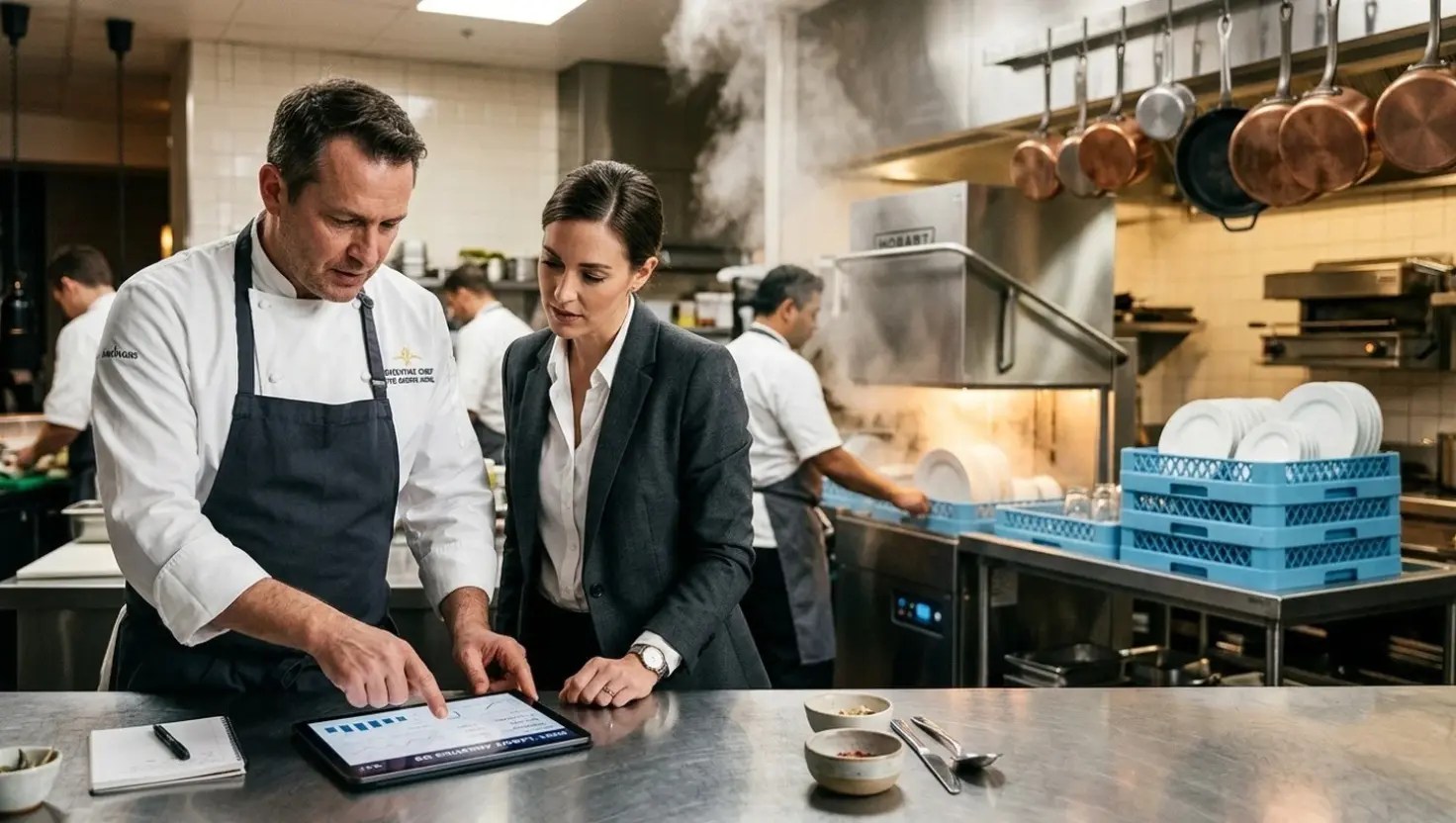
Behind the swinging doors of every high-volume restaurant, hotel banquet kitchen, and luxury catering venue, an unspoken operational truth exists: the dish pit is the heartbeat of the kitchen.
When clean saute pans, sanitized sizzle platters, and pristine wine glasses flow seamlessly, culinary lines run like clockwork. But the moment a scheduled kitchen steward no-shows on a Friday dinner service, the entire food and beverage machine grinds to a halt. Ticket times surge from 15 minutes to 45 minutes, executive chefs are forced to wash sheet pans in high-heat dish pits instead of expediting plates, and customer satisfaction plunges.
Yet, many hospitality executives still categorize kitchen utility staff as an interchangeable line item. This fundamental oversight hides one of the largest profit leaks in modern food and beverage operations.
According to hospitality labor analytics and the Bureau of Labor Statistics, the dishwasher turnover rate in commercial kitchens hovers between 75% and 150% annually—with monthly no-show rates averaging 15% to 25%.
In this comprehensive 2026 industry benchmark report, we break down the exact mathematical formula behind dishwasher churn, expose the hidden soft costs draining your balance sheet, and examine how forward-thinking hospitality groups leverage commercial dishwasher staffing solutions to achieve zero-downtime kitchen operations.
The 2026 Dishwasher Turnover Rate in Commercial Kitchens
Turnover in the hospitality sector has historically trended higher than any other private industry. However, back-of-house (BOH) utility roles experience churn that far outpaces front-of-house staff.
| Metric | Industry Average (All BOH) | Commercial Dishwashers & Stewards |
|---|---|---|
| Annual Turnover Rate | 73% – 85% | 110% – 150% |
| Average Tenure | 7.2 Months | 2.8 – 4.1 Months |
| Unannounced No-Show Rate | 8% – 12% monthly | 18% – 25% monthly |
| Average Days to Fill (Internal) | 14 – 21 Days | 18.5 Days |
Sources: National Restaurant Association State of the Industry, Cornell Hospitality Labor Studies, Bureau of Labor Statistics.
Why is the dishwasher turnover rate in commercial kitchens consistently the highest of any culinary department? Unlike line cooks or servers who possess clear career trajectories toward sous chef or bar manager positions, the traditional dishwashing role has historically suffered from three structural flaws:
- Extreme Physical Demands: Standing for 8 to 10 hours in wet, high-temperature environments, managing heavy dish racks, and chemical sanitization sinks.
- Low Switching Barriers: Entry-level utility workers frequently switch jobs for as little as $0.50 more per hour across town.
- Lack of Flexibility & Predictability: Inflexible shift structures and clunky paper scheduling leave workers feeling disconnected from management.
When an employee departs after only 60 days, what does it actually cost your venue?
The True Cost Formula: Calculating the Price Tag of Churn
Most hospitality controllers underestimate the real expense of turnover because they only track hard ledger items like recruitment job board fees. In reality, replacing a single hourly commercial dishwasher costs between $2,850 and $4,500 per occurrence, according to research adapted from Cornell University’s Center for Hospitality Research.
To see where this money goes, operators must evaluate the four tiers of the Dishwasher Churn Formula:
1. Hard Direct Costs (~$850 – $1,200)
- Job board postings (Indeed, ZipRecruiter, Craigslist): $250 – $400
- Criminal background checks, E-Verify, and payroll onboarding: $100 – $150
- Management interviewing, screening, and administrative processing: $500 – $650
2. Indirect Ramp-Up Costs (~$600 – $900)
- Trainer wage drag (senior utility stewards supervising new hires): $300
- Dish machine chemical miscalculations, detergent waste, and re-wash cycles: $150
- Increased china, glassware, and silver (CGS) breakage during peak rushes: $250
3. Operational Disruption & Overtime (~$1,400 – $2,400)
- Overtime wages paid to remaining staff covering vacant shifts: $900
- Executive Chef or Sous Chef pulling dish shifts at $35–$45/hour: $600
- Slower table turns, comped meals, and guest walkouts from delayed plating: $500+
For an upscale casual dining venue or hotel catering operation employing 4 full-time dishwashers with a standard 125% annual churn rate, the math is staggering:
- 5 turnover events per year × $3,450 average cost = $17,250 in annual profit erosion.
- In large hotel banqueting environments with 15+ kitchen stewards, this unseen tax routinely exceeds $50,000 annually.
The Hidden Operational Toll: How Dishroom Shortages Damage Revenue
The financial damage of high dishwasher turnover rates extends far beyond HR recruiting expenses. When your dishroom operates understaffed or staffed by untrained temporary workers, it triggers a catastrophic ripple effect throughout your entire establishment.
1. The RevPASH Collapse (Revenue Per Available Seat Hour)
When an elevated dishwasher turnover rate in commercial kitchens leaves back-of-house stations understaffed during peak dinner rushes, table turns collapse. If the kitchen runs out of clean appetizer plates or polished steak knives, service bottlenecks immediately.
- A 10-minute delay per table across a 120-seat dining room reduces total turns from 2.5 to 1.8 turns per evening.
- This delay represents thousands of dollars in lost top-line food and beverage revenue that can never be recovered.
2. High-Cost Labor Misallocation
When a dishwasher no-shows 30 minutes before banquet service, what happens? The Executive Chef, Sous Chef, or lead line cook is dragged away from culinary prep to scrape pans and feed conveyor dishwashers. Paying an Executive Chef earning $38–$48/hour to scrub pot sinks is an unsustainable misallocation of culinary talent that leads to chef burnout and management attrition. This costly misallocation of culinary leadership is the direct consequence of an unmanaged dishwasher turnover rate in commercial kitchens.
3. Glassware & China Breakage Surges
A high dishwasher turnover rate in commercial kitchens directly leads to excessive china, glassware, and silverware (CGS) breakage, as new hires rush through unfamiliar warewashing procedures. Rushing through backlogged dish pits leads to chipped porcelain, shattered crystal, and dangerous glass shards near food prep areas.
4. Health Department Violations & Food Safety Risks
Commercial sanitization is strictly governed by local health departments and OSHA safety protocols. Commercial dishwashers must maintain precise water temperatures (180°F for high-temperature sanitizing rinse) or precise chemical PPM concentrations (50–100 PPM chlorine for low-temperature machines). A volatile dishwasher turnover rate in commercial kitchens creates a constant influx of untrained staff who are unfamiliar with sanitization test strips or dish machine temperature logs expose venues to severe health inspection citations, fines, or temporary shutdowns.
4 Actionable Strategies to Combat Dishwasher Churn in 2026
Modern hospitality operators cannot afford the traditional “churn-and-burn” hiring cycle. To eliminate the root causes of the dishwasher turnover rate in commercial kitchens, forward-thinking leaders implement four proven operational strategies:
1. Elevate Stewarding Culture & Inclusivity
The simplest retention lever costs nothing: respect. High-retention restaurants do not treat dishwashers as invisible workers. They include utility staff in family meals, team huddles, and tip-out sharing pools. Recognizing stewards as “the protectors of the plate” builds lasting institutional loyalty.
2. Upgrade Ergonomics and Warewashing Equipment
Inspect your dish pit from an ergonomic perspective. Installing anti-fatigue rubber drainage mats, overhead high-pressure pre-rinse spray valves with balanced spring coils, and automated chemical dispensing pumps dramatically reduces physical fatigue. A cleaner, safer workstation directly lowers injury rates and voluntary walkouts.
3. Build Clear Internal Stepping Stones
Over 60% of commercial dishwashers express a desire to learn food prep, knife skills, and culinary techniques. Venues that establish formal cross-training—allowing stewards to graduate into prep cook or junior line cook roles—turn an entry-level dead-end job into an internal talent pipeline.
4. Bridge Gaps with On-Demand W-2 Commercial Dishwasher Staffing
Even with excellent retention policies, seasonal banquet surges, event volume spikes, and unexpected illnesses are inevitable. Relying on slow, traditional hiring ads takes an average of 18 days to fill an open shift.
Forward-thinking venues partner with specialized workforce agencies like TrueGigs to access pre-vetted, background-checked, and W-2 compliant kitchen utility staff. Whether you need a dedicated overnight deep-clean steward, high-temp conveyor machine operators for a 1,000-plate banquet, or immediate same-day emergency cover, on-demand staffing transforms a fixed overhead burden into a flexible, variable labor model.
Discover how TrueGigs eliminates back-of-house shortages through our dedicated commercial dishwasher staffing network.
Frequently Asked Questions (FAQ)
Q1: What is the average dishwasher turnover rate in commercial kitchens?
The average annual dishwasher turnover rate in commercial kitchens ranges between 110% and 150%, according to industry benchmarks from the National Restaurant Association and Cornell Hospitality studies. Due to high physical demands, unannounced no-show rates among entry-level utility stewards often reach 15% to 25% per month.
Q2: How much does it cost to replace a restaurant dishwasher?
Replacing a single commercial dishwasher costs between $2,850 and $4,500 per occurrence. This total includes direct hard costs (job advertisements, background checks, and management interviewing hours) and indirect costs (kitchen overtime, trainer wage drag, culinary disruption, and table turn slowdowns).
Q3: What are the main causes of high turnover among kitchen dishwashers?
The primary causes of dishwasher turnover include physically exhausting working conditions, inadequate sanitization training, lack of flexible scheduling, low perceived job dignity, and competitive wage shopping across competing restaurants.
Q4: How does on-demand commercial dishwasher staffing reduce labor costs?
On-demand commercial dishwasher staffing eliminates the ongoing fixed costs of recruitment advertising, interviewing, payroll administration, and workers’ compensation insurance. Instead of carrying excess payroll during slow operational days or paying overtime during staff call-outs, operators only pay for vetted W-2 stewards during scheduled shifts.
Protect Your Kitchen Profit Margins with TrueGigs
The dishroom should never be your restaurant’s operational bottleneck. Stop letting an unsustainable dishwasher turnover rate in commercial kitchens drain your management hours and eat away your food and beverage margins.
TrueGigs provides hotels, country clubs, fine dining restaurants, and high-volume catering venues with fully vetted, OSHA-compliant, W-2 commercial dishwashers and kitchen stewards on demand.
- Under 24-Hour Dispatch: Rapid shift fulfillment for scheduled events or emergency no-shows.
- 100% W-2 Compliance: Comprehensive payroll tax handling, workers’ comp coverage, and E-Verify verification.
- Trained Warewashing Stewards: Experienced in conveyor machines, chemical three-compartment sinks, and food safety sanitation.
Request Reliable Commercial Dishwasher Staffing Today or explore our complete hospitality workforce solutions.