
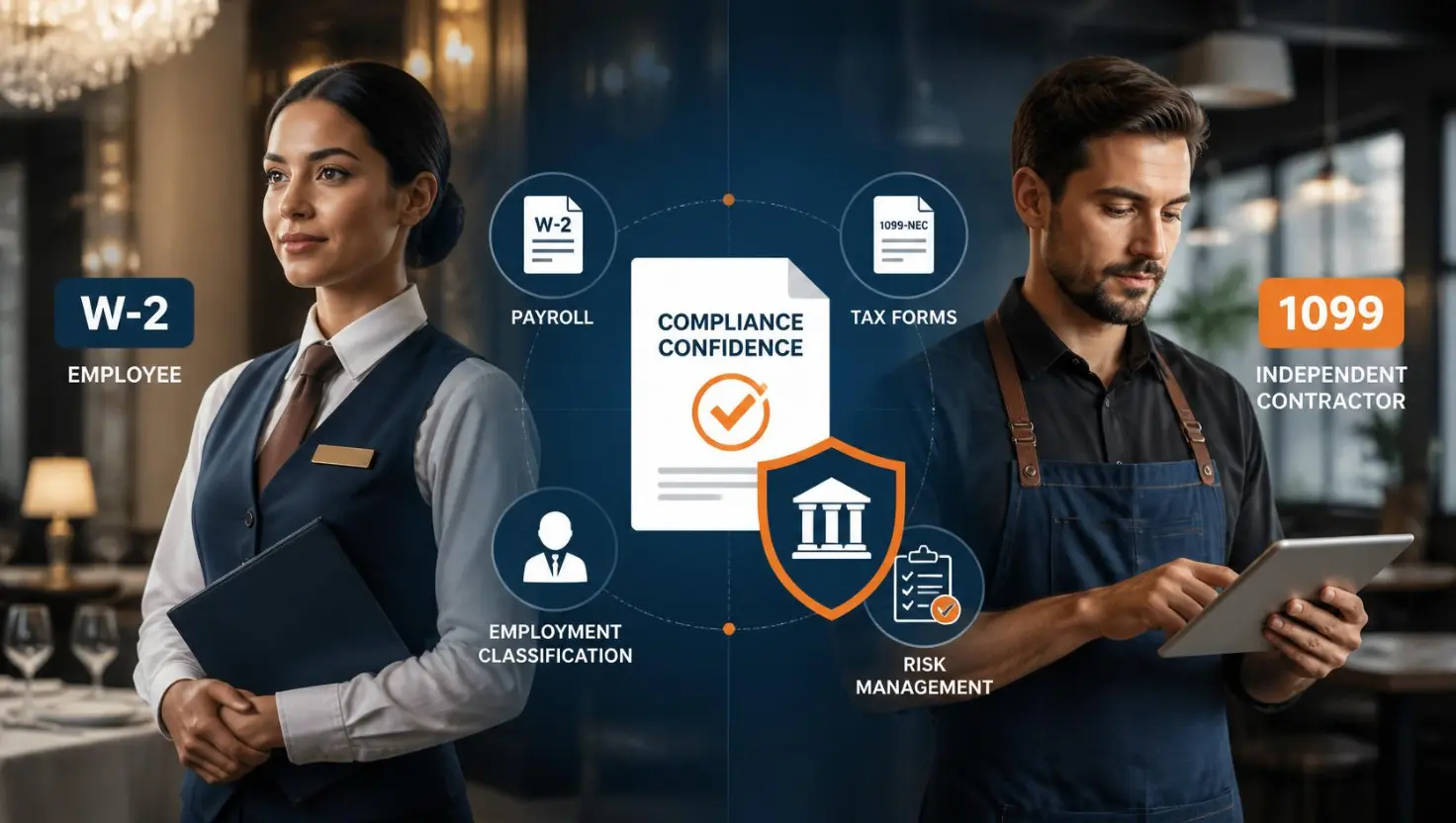
In the high-stakes world of hospitality management, few things are as stressful as a last-minute staff callout before a 1,000-person banquet. In the rush to fill shifts, many Hotel General Managers and Event Producers turn to gig economy apps or independent contractors. But in 2026, the temporary staffing landscape has fundamentally changed. The rise of intense regulatory scrutiny means that relying on 1099 gig workers for core hospitality functions is no longer just a gamble it is a massive legal liability.
This guide explores the critical differences between W-2 and 1099 hospitality staffing compliance, the severe financial consequences of IRS worker misclassification, and why top-tier hotels are shifting exclusively to W-2 event staffing models.
The Core Difference: W-2 Employees vs. 1099 Independent Contractors
To understand the legal risks, hotel operators must first understand the fundamental differences between how the IRS views these two classifications.
What is a 1099 Independent Contractor?
A 1099 worker is self-employed. According to federal labor laws, an independent contractor must have total control over how, when, and where they perform their work. They bring their own tools, set their own hours, and dictate their own methods.
In a true hospitality setting, such as a catered hotel event, this level of autonomy is virtually impossible. A banquet server cannot simply decide what uniform to wear, what time to serve the entrees, or how to plate the food. Because the hotel dictates the workflow, treating these workers as 1099 contractors immediately triggers compliance red flags.
What is a W-2 Employee?
A W-2 employee works under the direct control and supervision of an employer. The employer dictates their schedule, provides their uniform, mandates their training (such as TIPS or ServSafe certification), and directs their daily tasks.
Crucially, when you partner with a legitimate staffing agency that utilizes a W-2 model, the agency acts as the Employer of Record (EOR). The agency handles payroll taxes, unemployment insurance, and workers’ compensation liability. You get the staff you need without assuming the employment risk.
The Hidden Dangers of IRS Worker Misclassification
Many gig-economy staffing apps market themselves as a cheaper, faster alternative to traditional staffing agencies. They achieve these lower rates by classifying their workers as 1099 independent contractors, completely bypassing payroll taxes, overtime rules, and insurance requirements.
However, when a hotel utilizes these platforms, they unknowingly assume massive legal exposure. IRS worker misclassification is currently one of the primary targets for aggressive federal audits.
1. The Financial Devastation of a Hotel Staffing IRS Penalty
If the IRS determines that the 1099 workers you hired through a gig app were actually acting as employees (because your floor managers directed their work), your hotel can be held liable for misclassification. The penalties are severe and can include:
- Reimbursement of back wages and unpaid overtime.
- Retroactive payment of federal and state payroll taxes (FICA).
- Massive fines for failing to provide I-9 employment verification.
- Class-action lawsuits from the workers themselves for denied benefits.
For a hotel that regularly brings in 50 to 100 temporary workers for peak season conventions, a single hotel staffing IRS penalty can easily spiral into hundreds of thousands of dollars.
2. Workers’ Compensation Liability
Hospitality is a physically demanding industry. Slips in the commercial kitchen, back injuries from lifting tables, and burns are common occurrences.
If a W-2 employee provided by an agency like TrueGigs is injured on your property, the staffing agency’s workers’ compensation liability insurance covers the medical bills and lost wages.
If a 1099 independent contractor is injured on your property, they are not covered by standard workers’ compensation. Instead, they will likely sue your hotel directly for personal injury, targeting your general liability insurance. The cost of a single kitchen injury lawsuit far outweighs the few dollars saved by using a 1099 gig app.
3. The Co-Employment Risk
Even if a hotel tries to distance itself by using a third-party 1099 platform, they are not shielded from co-employment risk. If the Department of Labor determines that the hotel exerted significant control over the workers (e.g., disciplining them, tracking their hours, requiring specific uniforms), the hotel can be deemed a “joint employer.”
Once deemed a joint employer, your hotel is equally liable for any labor law violations committed by the third-party gig platform, including minimum wage violations and discriminatory practices.
Why Department of Labor Audits are Targeting Hospitality in 2026
The hospitality sector, specifically hotels, resorts, and large-scale event venues, relies heavily on contingent labor. Because of this, it has become a prime target for Department of Labor audits.
Recent regulatory updates at both the federal and state levels have made it increasingly difficult to classify temporary event staff as independent contractors. The “ABC Test,” adopted by several states, strictly mandates that a worker is an employee unless they perform work outside the usual course of the hiring entity’s business.
Since serving food, cleaning rooms, and managing guests are the core functions of a hotel, it is legally indefensible to claim that a banquet server or room attendant is an independent business operating outside your usual course of business.
The Strategic Advantage of W-2 Event Staffing
Transitioning your contingent labor strategy exclusively to W-2 event staffing is not just about risk mitigation, it is a massive operational advantage.
1. Superior Quality Control
Because 1099 contractors are legally independent, you cannot legally require them to undergo specific, unpaid training before they arrive on-site.
W-2 employees, however, can be heavily vetted, trained, and certified before they ever step foot in your hotel. When you partner with a W-2 agency, you can guarantee that every bartender arrives with a valid TIPS certification and every culinary worker is ServSafe certified.
2. E-Verify and Legal Compliance
In an era of strict immigration enforcement, knowing exactly who is working in your building is critical. Reputable W-2 staffing agencies utilize E-Verify and conduct nationwide background checks on every employee. This level of security is rarely guaranteed by 1099 gig platforms, which often rely on rapid, unverified onboarding to maintain their talent pools.
3. Brand Protection
When a VIP guest attends a corporate gala at your hotel, they do not know (or care) if the server handing them champagne is a full-time employee, a 1099 gig worker, or a W-2 agency temp. They only see your brand.
W-2 staffing agencies are heavily invested in the performance of their employees. They provide proper uniforms, enforce grooming standards, and handle disciplinary actions internally, ensuring that your brand reputation is fiercely protected.
Protect Your Hotel with Guaranteed Hospitality Staffing Compliance
The math is simple: the minor hourly savings offered by 1099 gig economy apps are completely eclipsed by the massive legal, tax, and insurance liabilities they create.
In 2026, hospitality staffing compliance requires a proactive approach. TrueGigs operates exclusively on a W-2 employment model. When you partner with us, we act as the Employer of Record. We handle the payroll taxes, we carry the workers’ compensation liability, and we ensure every single worker is E-Verified and thoroughly vetted.
You get the reliable, highly-trained staff you need to execute flawless events, with absolutely zero compliance anxiety.